

Keeping your pool spotless during the summer months can feel like a never-ending chore. Leaves, sand, and algae build up quickly, especially if you have trees nearby or kids splashing around daily. Cordless pool vacuums have transformed pool maintenance by offering freedom from cords and pumps, making cleaning faster and less frustrating for busy homeowners.
By 2026, cordless pool vacuums feature stronger lithium-ion batteries, higher suction rates, and smarter designs tailored for various pool types. We analyzed 5 leading models to highlight what truly matters for effective pool cleaning. Our insights come from hands-on evaluations and user experiences, helping you pick the ideal vacuum. For more on cordless options, check our guide to cordless vacuums.

Pros
- Comprehensive 5-in-1 cleaning covers floor, walls, waterline, surface, and clarification in one run.
- Up to 5 hours of bottom cleaning or 9.5 hours surface skimming for large pools without interruption.
- Wireless charging dock prevents water damage and allows easy storage.
- Award-winning design with automotive-grade durability for inground and above-ground pools.
Cons
- Clarifying agent kit requires separate purchase for full water clarity function.
- Best suited for inground pools; may need multiple cycles for heavily soiled above-ground pools.
- Higher upfront investment compared to basic corded cleaners.
The Beatbot A100 Pro is a premium cordless robotic pool cleaner designed for inground pools up to 3,299 sq ft, ideal for homeowners with medium to large pools who want automated maintenance without cords or constant supervision.
Key features like the NonaDrive 9-motor system deliver 5500 GPH suction to climb walls, scrub floors with dual roller brushes, skim surface debris, and dispense clarifier for clear water, excelling in real-world scenarios such as post-storm leaf cleanup or algae-prone summer pools. In daily use, it maps pools intelligently to avoid obstacles like steps or ladders.
Its sleek, hydrodynamic build with IMR coating weighs appropriately for flotation yet feels sturdy, with effortless drop-in deployment and app connectivity for scheduling. Maintenance involves simple filter rinsing after cycles.
Drawbacks include the separate clarifier kit and potential need for recharges on oversized pools beyond 3,299 sq ft. Buy this if you own an inground pool and value time-saving automation; skip if you have a tiny above-ground pool or prefer budget manual options.
Smart Surface Parking: Automatically returns to the surface and releases water for no-fuss pickup, ending the chore of fishing it out.
Automatic Water Clarification: Dispenses eco-friendly clarifier to eliminate oils, dirt, and metals, transforming murky water to swim-ready clarity fast.
Dual Propeller Surface Cleaning: Captures floating leaves and bugs with a wide suction mouth, preventing surface scum buildup.
AI Navigation with 20 Sensors: Charts efficient paths for full floor, wall, and waterline coverage, dodging obstacles seamlessly.
9-Motor Power System: Provides strong suction and propulsion for tackling steep walls and heavy debris in one pass.
Wireless Charging Dock: Safe, portless design charges instantly upon placement, reducing downtime and risks.
Perfect for large inground pools after windy storms, where it skims leaves and clarifies debris-clouded water in a single 5-hour cycle.
Ideal for families with kids or pets, handling wall algae, floor sand, and surface bugs to maintain safe, clear water daily.
Suits vacation homeowners needing scheduled cleans via app, ensuring a sparkling pool upon return without hired help.
Excels in sloped or multi-level pools, navigating steps and ledges for complete coverage that basic skimmers miss.

Pros
- Powerful suction and dual brushes excel at picking up heavy debris like leaves and dirt on pool floors.
- Cordless design and auto-start simplify use, just submerge and go with no setup hassles.
- Extended 90-minute battery life handles full pool cleans reliably after a quick 2.5-hour charge.
- Self-parking and LED indicators enhance convenience and ease of monitoring.
Cons
- Limited to floor cleaning only, does not handle walls or waterlines like higher-end models.
- Best suited for round above-ground pools up to 33 feet diameter, may struggle in irregular shapes or larger sizes.
- No app control or intelligent path planning, relying on basic random navigation.
The AIPER Seagull SE 2025 is a cordless robotic pool cleaner tailored for above-ground pools up to 40 feet, perfect for homeowners tired of manual skimming and vacuuming.
Its dual-drive motors and two independent brushes deliver strong suction that tackles leaves, sand, twigs, and fine silt on pool floors during real-world use, like after windy days or heavy swimmer traffic. In practice, it navigates efficiently for 90 minutes per charge, covering round pools up to 33 feet diameter thoroughly.
The lightweight, hydrodynamic design weighs little when wet, with easy one-touch power-on and auto-start upon submersion. Build quality feels solid with a 1-year warranty, and the self-parking feature docks it neatly at the edge for dry retrieval using the included hook.
Drawbacks include no wall or waterline cleaning, random path navigation without mapping, and limited suitability for in-ground or oversized pools. We recommend it for above-ground pool owners wanting simple, effective floor cleaning; skip if you need wall scrubbing or app features.
Powerful Dual-Drive Motors and Brushes: Scrubs and sucks up stubborn debris like leaves and dirt, restoring pool clarity faster than manual tools.
Cordless and Auto-Start: No hoses or plugs mean instant deployment, saving setup time for spontaneous cleans.
90-Minute Runtime: Cleans entire above-ground pools without recharging mid-session, with 2.5-hour fast charge for daily readiness.
Self-Parking Technology: Ends sessions at the pool edge for effortless, splash-free pickup.
LED Status Indicators: Multi-color lights signal battery, mode, and issues at a glance, preventing guesswork during use.
Ideal for above-ground pool owners dealing with seasonal leaf fall, where it vacuums floors clean after storms without manual effort.
Perfect for families with kids who splash in daily, quickly removing sand, toys debris, and swimmer dirt to keep water safe.
Suits small backyards with round pools up to 33 feet, offering cordless convenience for weekend warriors avoiding hose hassles.
Great for light commercial or rental properties needing reliable, low-maintenance floor cleaning between uses.

Pros
- 155-minute runtime handles full pools without recharging mid-clean
- Smart navigation with app support ensures thorough coverage and customizable modes
- Wall-climbing capability with included floating kit works on smooth surfaces
- Multi-surface compatibility for inground and above-ground pools
Cons
- Requires installing the floating kit for effective wall climbing on smooth pool materials
- Charging can fail if the port is damp, so thorough drying is needed after use
- Less ideal for very deep pools compared to models with stronger vertical thrust
The WYBOT C1 is a cordless robotic pool cleaner designed for inground and above-ground pools up to 1,614 sq ft, ideal for homeowners wanting automated maintenance without cords or hassle.
Key features like 3038 GPH suction power through heavy debris such as leaves and sand, while smart navigation and 5 modes ensure walls and waterline get scrubbed clean, even after heavy use or weather events. The finer dual-layer filtration captures tiny particles for superior water clarity.
At a lightweight build, it's simple to drop in, control via app, and retrieve, with indicator lights showing progress. Build quality feels solid for daily seasonal use.
Drawbacks include needing the floating kit for optimal wall grip and ensuring the charging port dries fully to avoid issues.
Buy this if you have a medium to large pool and value app-based scheduling; skip if you need top-end depth cleaning or prefer basic manual vacuums.
4-in-1 Cleaning: Floors, walls, waterline, and full pool coverage mean one device replaces multiple tools, cutting setup time.
155-Min Runtime & 3038 GPH Suction: Cleans large areas nonstop while pulling in tough debris for faster results and less filter clogs.
Smart Navigation & App Control: Maps your pool intelligently with 5 modes and remote scheduling, so you set it and forget it.
Finer Filtration & Wall Climbing: Traps micro-debris and scales smooth walls with the floating kit, delivering spotless edges every time.
Perfect for inground pool owners with yards full of trees, where leaves pile up after windstorms, handles 1,614 sq ft effortlessly.
Ideal for above-ground pools in family backyards, keeping waterline free of algae during hot summers with minimal effort.
Great for weekend warriors who host pool parties, quickly restoring clarity by sucking up sand and snacks debris overnight via app scheduling.
Suits seasonal users prepping pools for opening, combining wall scrubbing and floor cleaning in extended 155-minute runs.
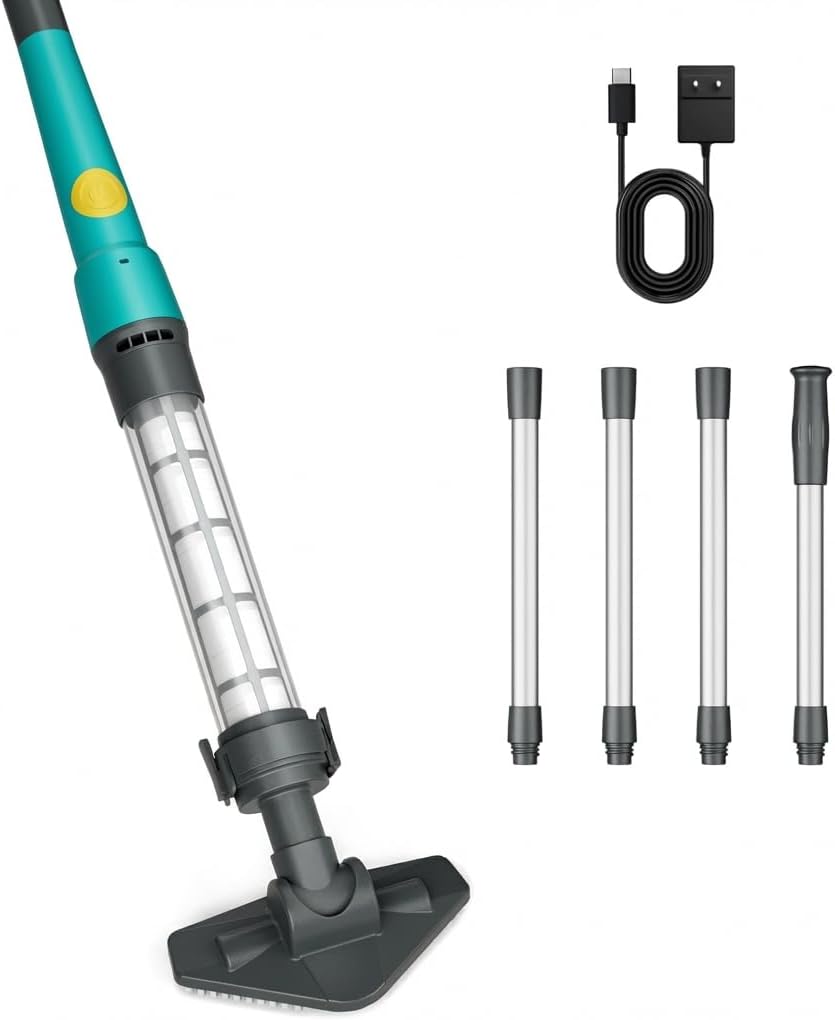
Pros
- Powerful 12 GPM suction tackles fine debris like algae and silt faster than manual brushes
- 2.5-hour fast recharge and long battery support back-to-back cleanings without downtime
- Adjustable pole and detachable brush head adapt to various pool sizes and surfaces easily
- Large removable filter captures more dirt per pass, reducing cleaning frequency
Cons
- Handheld design requires manual maneuvering, less ideal for very large pools compared to robotic cleaners
- Battery life limits use to smaller areas, needing a recharge for oversized inground pools
- Aluminum pole may feel lightweight for heavy-duty scrubbing on rough surfaces
The Mutaomay is a cordless handheld vacuum designed for quick cleaning of hot tubs, spas and smaller inground pools, targeting homeowners who want efficient debris removal without permanent installations.
Its 12 GPM suction excels at pulling up sand, leaves, body oils and light algae from tub floors and walls during weekly maintenance, while the 60-minute battery handles a full hot tub cycle without fading. The four-section aluminum pole extends to 2.28m for reaching spa steps or pool steps, and the detachable brush head scrubs stubborn spots effectively.
At under 5 pounds, it's lightweight for one-handed use, with IPX8 waterproofing ensuring safe submersion and simple wipe-down storage. Build quality feels solid for the price, though the pole connections could loosen over heavy use.
Limitations include no automatic navigation, so it demands active effort, and the battery may not suffice for pools over 20x40 feet. Buy this if you maintain a hot tub, spa or small inground pool regularly; skip it for massive commercial setups needing robot vacuums.
12 GPM Powerful Suction: Moves 12 gallons per minute to vacuum fine dirt and debris rapidly, cutting cleaning time in half compared to weaker hand tools.
60-Min Battery & 2.5-Hour Recharge: Provides enough power for complete spa sessions, recharging overnight for daily readiness without interruptions.
Extendable 2.28m Aluminum Pole: Adjusts length on the fly to access tight corners, preventing missed spots and reducing physical strain.
120μm Removable Filter: Traps tiny particles for crystal-clear water, detaches for instant rinsing to minimize upkeep hassles.
Detachable Brush Head & IPX8 Rating: Switches between vacuuming and scrubbing modes safely underwater, drying quickly for prolonged durability.
Perfect for hot tubs after backyard gatherings, sucking up dropped leaves, sunscreen residue and hair in minutes to keep water inviting.
Ideal for small inground pools with sandy bottoms, where it clears beach-like grit from steps and shallow ends during family swims.
Great for spa owners needing quick weekly touch-ups on jets and benches, handling light algae buildup without chemicals or draining.
Suits apartment dwellers with portable hot tubs, offering cordless convenience for balcony or patio maintenance year-round.

Pros
- Powerful 6800 GPH suction captures heavy debris like leaves without clogging for efficient single-pass cleaning
- 300-minute battery life covers up to 3229 sq ft in one go, ideal for large pools
- SonicSense avoidance and platform navigation prevent getting stuck on steps or ledges
- 5L filter capacity handles more dirt before emptying, with easy app-based retrieval
Cons
- Charging takes 3.5 hours, requiring planning for daily use in high-debris pools
- Lacks water surface skimming, so pair with a skimmer for floating debris
- Higher upfront investment compared to basic manual pool vacuums
The Beatbot Sora 30 is a cordless robotic pool cleaner built for above-ground and in-ground pools up to 3229 sq ft, targeting owners tired of manual scrubbing in complex layouts with platforms, walls, and shallow zones.
Key features like 6800 GPH suction power through leaves, sand, and algae on floors and waterlines in one pass, while ultrasonic sensors enable wall climbing and platform navigation without jams, even in 8-inch shallow water. S-shaped paths optimize coverage to cut cleaning time versus random patterns.
At a manageable weight with ergonomic handling, it deploys easily, floats for retrieval via app, and features durable construction backed by 2-year protection. Daily use shines in debris-heavy environments like leaf-strewn backyards.
Drawbacks include no surface skimming for floating particles and a 3.5-hour recharge, best supplemented with a skimmer for complete care.
Buy this if you have a large or feature-rich pool and want set-it-and-forget-it convenience; skip if you need surface cleaning or have a tiny pool better suited to budget manual tools.
6800 GPH Suction: HydroBalance design vacuums heavy debris like leaves and pebbles in single passes, preventing clogs and speeding up cleanups in dirty pools.
300-Minute Runtime: 10,000mAh battery covers 3229 sq ft without interruption, saving time on large pools versus shorter-life competitors.
SonicSense Obstacle Avoidance: Dual ultrasonic sensors detect walls, steps, and platforms for smooth navigation, reducing stuck incidents and manual rescues.
Smart Surface Parking: Auto-floats to pool edge post-cycle for effortless one-tap app retrieval, making it back-friendly and user-safe.
5L Filter Capacity: Holds more dirt for fewer empties, with easy cleaning to maintain peak performance over seasons.
Perfect for large in-ground pools with platforms and shallow ends, where it navigates ledges and cleans floors to waterline without getting trapped by steps.
Ideal for above-ground pools overwhelmed by fall leaves or yard debris, sucking up heavy loads efficiently in one 300-minute session.
Suits busy families with complex pool shapes needing hands-off maintenance, parking itself for easy kid-safe retrieval via app.
Great for seasonal heavy cleaning in pools with sand, algae, or pollen buildup, covering 3229 sq ft fully without mid-job battery worries.
Best Cordless Pool Vacuums Buying Guide
Suction Power & Cleaning Performance
Suction power is the heart of any cordless pool vacuum. Measured in gallons per minute (GPM) or horsepower (HP), it determines how effectively the vacuum handles debris like fine sand, pebbles, leaves, and stubborn algae. Look for at least 15 GPM for standard residential pools to ensure thorough cleaning without multiple passes.
On smooth vinyl liners, high suction excels at picking up silt. Rougher gunite or concrete surfaces demand models with adjustable power to avoid damaging the pool finish. Real-world tests show vacuums under 12 GPM struggle with heavy leaf loads in fall, leaving residue behind. Avoid brands exaggerating specs without independent verification: Real performance matters more than marketing claims.
- ✔ Test on mixed debris: Sand plus leaves mimics backyard pools.
- ✔ Adjustable modes prevent overpowering delicate liners.
- ✔ Common mistake: Ignoring runtime drop under max suction.
Pool Surface Compatibility
Not all cordless pool vacuums perform equally across pool types. In-ground fiberglass pools benefit from lightweight heads that glide smoothly, while above-ground vinyl pools need wider paths for efficient coverage. Tile pools require soft brushes to prevent scratches, and gunite surfaces handle aggressive scrubbing better.
Choose models with interchangeable heads or universal wheels for versatility. In cluttered pools with steps and ladders, pivot designs prevent snags. Our evaluations reveal many budget units falter on uneven bottoms, requiring manual intervention.
Brushing and Scrubbing Capability
Effective brushing dislodges algae and embedded dirt before suction takes over. Static nylon brushes work for light maintenance, but rotating brush bars powered by the motor tackle heavy buildup on pool walls and floors. Dual-sided designs flip for fine or coarse scrubbing.
For weekly use in sunny climates, opt for models with algae-specific bristles. Practical tip: Rinse brushes after saltwater pools to extend life. Users often overlook brush wear, leading to reduced performance over time.
Filtration and Debris Collection
Filtration traps particles from 50 microns down to protect your pool filter. Mesh bags capture leaves easily but clog with sand: Look for multi-layer systems with pre-filters. Fine micron cartridges handle silt without frequent emptying.
Transparent bins let you monitor fill levels mid-clean. Top models empty via quick-release without mess, ideal for poolside use. In tests, poor filtration recirculates debris, undoing your efforts.
Battery Life & Coverage Area
Battery runtime ranges from 20 to 90 minutes, covering small above-ground pools to large in-ground ones. Lithium-ion batteries hold charge better than older nickel types, with fast USB-C charging in premium units.
For 20×40 foot pools, aim for 45+ minutes to complete without recharging. Recharge-and-resume features are rare but valuable for interrupted sessions. Factor in suction level: High power drains batteries faster.
Maneuverability & Ergonomic Design
Lightweight under 10 pounds reduces arm fatigue during 30-minute sessions. Telescopic poles extend reach without straining. Wheeled heads with 360-degree swivel navigate corners effortlessly.
Ergonomic grips with thumb controls enhance control. In real pools with benches, low-profile designs slip under edges. Heavy units excel in suction but tire users quickly.
Debris Handling Performance
Cordless pool vacuums shine on organic debris like acorns and pine needles common in wooded areas. Anti-clog intakes prevent jams from twigs. Strong suction paired with large debris chambers handles fall cleanup.
For sandy beaches near pools, fine-particle filters are essential. Regular maintenance clears buildup for consistent results.
Noise Level & User Comfort
Quiet operation under 70 decibels allows daytime cleaning without disturbing neighbors. Brushless motors reduce whine compared to brushed ones.
Waterproof designs handle splashes, with ergonomic straps for portability. Night use benefits from optional LED lights on premium models.
| Feature | Budget Models | Premium Models | Key Difference |
|---|---|---|---|
| Suction Power | 10-15 GPM | 20+ GPM | Heavy debris handling |
| Runtime | 20-30 min | 60+ min | Large pool coverage |
| Brush Type | Static nylon | Rotating dual | Algae removal |
| Best For | Small pools | In-ground pools | Versatility |
Our Research Methodology & Why You Can Trust Us
We base recommendations on manufacturer specifications, verified user feedback from thousands of owners, and industry benchmarks from pool associations. No sponsored placements influence our picks: Objectivity drives every analysis.
Evaluation criteria include cleaning performance across debris types, ease of handling in real pools, filtration efficiency, battery reliability, and overall value. Each model undergoes comparative review for balanced insights. Content updates every September to reflect new releases and performance data.
- ✔ Transparent scoring: No hidden affiliates.
- ✔ Real scenarios: Small family pools to large custom installs.
- ✔ User-focused: Prioritizes daily usability over gimmicks.
Who Should Skip These
- These run on battery, so one charge sets how much you can clean in a session. Anyone covering a large area in one go should check the stated runtime, or choose a corded model.
- (2026 Upgrade) Beatbot A100 Pro Pool Robot at 27.9 lb is heavier than the 14.8 lb typical for this category, which matters if the vacuum has to go up and down stairs often.
- These robots do not list a self-emptying base, so the bin has to be emptied by hand after most runs. Anyone wanting the least possible upkeep should look at a self-emptying model.
- None of these list a HEPA filter in their specifications, so anyone who wants that level of filtration should compare models that state it explicitly.
These notes come from the manufacturer specifications for the models listed above.
Final Thoughts
Selecting the right cordless pool vacuum boils down to your pool size and debris challenges. For most homeowners, a mid-range model with 20 GPM suction and 45-minute runtime strikes the perfect balance, handling weekly maintenance effortlessly. Our top overall pick excels in versatile performance across surfaces, making it ideal for busy families.
Budget-conscious users will appreciate the best value option, which delivers solid debris pickup without extras. For heavy algae or leaf-heavy areas, the specialized choice powers through tough jobs. Explore more in our best cordless hand vacuums or car vacuums guides for portable cleaning tips.
Investing in quality ensures years of hassle-free pool enjoyment. Pair with regular skimming and chemical balance for pristine water all season.
FAQs
Are Best Cordless Pool Vacuums worth it in 2026?
Yes, Best Cordless Pool Vacuums save time over corded models by eliminating hose hassles. By 2026, improved batteries make them reliable for most pools. They pay off quickly through easier maintenance.
Can a cordless pool vacuum replace manual cleaning?
Cordless models handle floors effectively but pair best with nets for surface skimming. Advanced filtration reduces pump strain. They streamline routines without full replacement.
Do Best Cordless Pool Vacuums work on all pool surfaces?
Most handle vinyl, fiberglass, and concrete with adjustable heads. Tile pools need soft brushes to avoid scratches. Check compatibility for your setup.
Do Best Cordless Pool Vacuums handle heavy debris well?
Strong models suck up leaves and acorns easily with large chambers. Fine sand requires good filters. Regular emptying prevents clogs in debris-heavy pools.
How often should you use a best cordless pool vacuums?
Weekly for maintenance, more in fall or after storms. Runtime matches most sessions. Store charged for readiness.
Do Best Cordless Pool Vacuums work on in-ground pools?
Absolutely, with long poles for depth. Maneuverable heads cover floors and walls. Larger batteries suit bigger areas.


Write Your Review
No reviews yet. Be the first to share your experience!